Until your kids are about 6 years old, you will probably have to brush their teeth for them. After that, though, it will be up to them to do it on their own. Teaching kids to brush their teeth is not always an easy part of parenting, but it's something that must be done. To make the process a little easier on you and your kids, try following the suggestions below.
Being Practical
1. Brush your kids' teeth for them to demonstrate how to do it properly. Then let them to do it by themselves to prove how "grown up" they are. Continue doing this for as many days or weeks as is necessary for proper instruction.
2. Demonstrate proper tooth brushing by having your child watch as you brush your own teeth. Then let your child brush your teeth also. Laugh and make it a fun event, showing your child how pleasant tooth brushing can be.
3. Explain to your kids what happens when they don't brush their teeth. Tell them about plaque and the germs that will eat away at their teeth if they don't brush. Many kids will respond positively when presented with this information in a rational, grown-up way.
4. Give your child a tablet to chew that will turn areas on the teeth colorful that have not been properly brushed. This technique will clearly show your child the effects of not brushing properly and motivate him or her to brush more thoroughly.
5. Use consistently good dental hygiene yourself. Your children, eager to emulate their much-loved parent, will follow suit.
Making it Fun
1. Recommend to your kids that they brush their doll's teeth. This will incorporate play with practical instruction, and it will also put them in the "parent" role of tooth brushing, making them feel a little more important.
2. Inspire your kids to brush their teeth by making it a fun activity rather than a chore. Invent a game or a song to accompany tooth brushing. Show enthusiasm so that brushing their teeth is something your kids will want to do.
3. Take turns brushing teeth with your child and you or older siblings. Let your child brush for 10 seconds or so, praise him or her, then brush your own teeth for 10 seconds. This allows parent-child interaction while giving your child the autonomy he or she wants.
4. Buy a selection of three or four toothbrushes when first teaching kids to brush their teeth. Let them select which toothbrush they want to use each time. This way your kids will feel like they have some control over the situation.
5. Consider buying an electric toothbrush for your kids. This will make brushing easier and more enjoyable for them, and it is more effective than manual brushing.
http://www.ehow.com/how_2077414_teach-kids-brush-their-teeth.html
Thursday, April 22, 2010


Wednesday, April 7, 2010
Another Successful "Give Kids a Smile"
25,188 children seen by 12,877 dentists and 36,884 other volunteers . . . Wow!!!
Dear Give Kids A Smile Coordinator:
As we reflect on our most recent Give Kids A Smile care day, it’s clear that our shared national success is built upon your unique community efforts at more than 2,000 events across the country. Each one demonstrated “home town” care and concern for underserved children. We cannot think of a better way to thank you than by sharing the following, sent to the ADA by a grateful Mom the evening of the nationwide event:
Today my 10 yr old son was treated by your "give kids a smile" program. I can't begin to find words to thank your organization, the wonderful staff that treated him, and any others involved with this program. Today was not just about my son getting beyond some horrible dental issues (he had six extractions and two fillings), it was about giving my son confidence, self esteem, a smile, a new outlook on life, and a brighter future. I pray that you know what dental care can do for a child who has not had it available and how incredibly grateful we are to everyone. You've changed his life with your mission and generosity and I wanted to make sure you knew this. Please feel free to share this with dentists, students and donors. If there is a single way I can help this program continue, please let me know. Again, thank you deeply, and God bless you.
Plans called for an astounding 325,188 children to be seen by 12,877 dentists and 36,884 other volunteers. Again this year, Henry Schein Dental donated professional product valued at $1,050,000. DEXIS donated the use of its equipment and staff to all dental schools requesting that assistance, valued at $1,000,000. And Colgate donated $750,000 in toothbrushes and toothpastes. What a team! We are so proud they have supported us for so many years.
Warmest thanks,
Ronald L. Tankersley, D.D.S.
President
Monday, March 29, 2010
Seal the Deal: Information about dental sealants

What are dental sealants?
Dental sealants are made of plastic and are applied to the chewing surfaces of the back teeth to prevent decay. The plastic fits into the depressions and grooves (pits and fissures) of teeth. The sealants protect tooth enamel from the bacteria and acids that cause decay.
Why can’t I just brush and floss?
While brushing and flossing help to remove food particles and plaque from smooth surfaces of teeth, toothbrush bristles often can’t reach into the teeth’s depressions and grooves. Sealants protect those areas and prevent food and bacteria from getting in.
How does the dentist apply a sealant?
Your dentist can apply sealants easily, and it takes only a few minutes to seal each tooth. The dentist first cleans the teeth that will be sealed, which may require the use of a dental drill to open the grooves of the teeth and determine if decay is present. Then he or she will roughen the chewing surfaces with an acid solution, which will help the sealant stick to the teeth. The dentist then “paints” the sealant on the tooth. It bonds directly to the tooth and hardens. Sometimes your dentist will use a special curing light to help the sealant harden.
Aren’t sealants just for kids?
Decay can begin early in life, so dentists usually apply sealants to children’s and teenagers’ premolars and molars to protect them. But sealants can protect adults’ teeth, too. Ask your dentist about sealants for your children or for yourself to see if they would be beneficial.
How long do they last?
As long as the sealant remains intact, the tooth surface will be protected from decay. Sealants hold up well under the force of normal chewing and usually last several years before a reapplication is needed. The risk of decay decreases significantly after sealant application. During your regular dental visits, your dentist will check the condition of the sealants and reapply them when necessary.
Are sealants safe?
Sealants are extremely safe, though some people may have an allergic reaction to the plastic. Talk to your dentist if you or your children have allergies so that he or she can provide the best treatment options.
Will my insurance pay for sealants?
Health insurance usually will pay for sealants for children’s and teenagers’ permanent molars. If the dentist suggests sealants for other teeth, he or she will tell you whether or not the costs will be covered. Be sure to check with your dental insurance company about your insurance plan as coverage may vary.
Seal the Deal
Your dentist can apply sealants easily, and it takes only a few minutes to seal each tooth.
Provided by the Academy of General Dentistry
For more patient information, check out our education video library: Vail Valley Dental Care Patient Education
Sunday, March 28, 2010
ESPN Magazine: Six Things You Should Know About Treating NHL Teeth

2. Guys Play Through Pain ... "Players endure things average patients wouldn't. They'll shrug off chipped teeth or abscesses, because they don't want to lose playing time. 'Whatever it takes' is their motto. Last year, Cam Ward's wisdom tooth bothered him during the playoffs. He wasn't about to miss those games, so we postponed surgery and calmed it with antibiotics."
3. ... To A Point. "This is hockey, so it gets ugly. Once, a player took a stick to the mouth and it pushed in his lower teeth. But they were still attached to his gums, so we were able to reimplant them into the sockets. Another time, a Rangers star had his front tooth knocked out-but just one tooth. How he got hit with so much force in such a small area still boggles me."
4. Sometimes We Need Reinforcements. "There's a division between older and younger guys. Some vets skate with four front teeth missing, but young guys are concerned about cosmetics. Even so, lots of guys won't fix anything until they retire. I try to encourage them not to wait that long. Wives can act as influences. If I can't get through to a guy, I'll appeal to his wife. She'll make sure it happens."
5. Emergencies Happen. We're on call for practices-with all those pucks flying around, there's a high chance of injury. Players get priority access. If the trainer calls, we have them bring the injured guy to our office and we reschedule patients. Some patients are more understanding than others."
6. We Do It for The Love Mostly. "We don't get a direct stipend. We do this for perks: tickets, travel with the team and gifts. But players are covered through a league dental plan and workers' comp. So if we treat an injury, we do get paid."
By Gabriel J. Rich, Hurricanes Team Dentist
(As Told To Anna Katherine Clemmons)
Photograph By Tony Pearce
Article Is Property Of ESPN © 2010
Friday, March 5, 2010
We're rooting for our friends Olivia Swift and Caroline Byrne in the Junior Olympics this weekend

Ski and Snowboard Club Vail's Caroline Byrne stays in a tight tuck through the flats of the downhill course Thursday during training for the Junior Olympics race at Golden Peak in Vail. Byrne tied for first with Aspen's Danielle Brownell-Patty in Thursday's training.
http://www.vaildaily.com/article/20100304/SPORTS/100309750&parentprofile=search
http://www.vaildaily.com/article/20100304/SPORTS/100309739&parentprofile=search
Thursday, March 4, 2010
10 Bad Dental Habits to Break

1. Brushing too hard
Using a firm-bristled toothbrush and too much pressure can permanently wear away protective enamel (triggering tooth sensitivity and cavities) and cause receding gums. Instead, use a soft brush and gentle, circular scrubbing motions for two minutes at least twice a day. When buying a toothbrush, consider that compact heads move most easily around small mouths and long, flexible handles are better than short, stiff ones for reaching back molars.
Also to consider: Going electric. Because they do the hard part for you (and do it correctly), electric toothbrushes may help you remove more plaque than manual brushes. A 1997 study published in the Journal of Clinical Dentistry showed that electric toothbrushes improved periodontal health in adults with gum problems.
2. The wrong toothpaste
Some toothpastes, especially those designated "tartar control," are too abrasive. Anything that feels gritty can erode enamel and cause receding gums. Fluoride is the only ingredient you need. Dentist-recommended toothpastes include: Mentadent ($3.29), Tom's of Maine Natural Toothpaste ($4) and Sensodyne Fresh Mint ($4.39) for sensitive teeth.
3. Forgoing floss
Bacteria on your teeth can develop into plaque, the leading cause of cavities and gum disease, in 24 hours. Flossing once a day is essential for removing plaque.
4. Drinking lots of soda
Carbonated sodas—both diet and regular—contain phosphoric acid, which can erode teeth over a period of time. If you drink soda, use a straw to minimize contact with your teeth—and brush afterward.
5. Foods that stain
Tooth enamel is like a sponge. Anything that leaves a stain in a cup or on a plate (for example, coffee, tea, colas, marinara sauce, soy sauce, red wine) will give teeth a dull, yellowish color over time. Ask your dentist about laser whitening, bleaching or Prophy Power, a new in-office procedure in which sodium bicarbonate (a gentle whitening agent) mixes with a powerful jet of water to lift stains without removing enamel.
If you want to use a whitening toothpaste, consider that they can brighten teeth a few shades, but they tend to be harsh on the enamel.
6. Frequent snacking
Every time you eat something, especially if it's a sugary or starchy food, the bacteria that normally live in your mouth create acids to break down the food. But these acids can also attack teeth, leading to decay. Eating raw, firm fruits and vegetables (like apples and carrots) with and after meals can help. (Many dental experts consider such foods to be nature's toothbrushes because of their detergent-like effect on plaque.)
Chewing sugarless gum after eating can also help prevent cavities by increasing saliva flow, which helps wash away cavity-causing bacteria. Look for gum sweetened with Xylitol. Researchers at the University of Minnesota in Minneapolis found gum containing the natural sweetener temporarily inhibited bacterial growth which leads to decay.
7. Using teeth as tools
Ripping open potato-chip bags and loosening knots with your teeth can lead to cracks and breaks and damage fillings and existing dental work. Also risky: Chewing ice cubes, frozen candy bars or hard candies.
8. Neglecting problems
Bleeding gums and chronic bad breath are hallmarks of gum disease. To fight bad breath, drink enough water to keep your mouth moist (water and saliva help control bacteria) and remove excess bacteria with a tongue scraper. To prevent bleeding gums, brush and floss daily. If your symptoms persistent longer than a few days, consult your dentist.
9. Avoiding the dentist
You're probably familiar with the advice that you should schedule twice-yearly cleanings—but that's actually an arbitrary recommendation. We now know that some people may actually need to see a dentist every three months to keep gum disease at bay.
10. Ignoring your lips
No matter how great your dental health, your smile still won't shine if it's framed by dry, cracked lips. Lip skin, which is thinner than other skin on the body, is prone to moisture loss, environmental damage and changes due to aging. Using a moisturizing balm daily will help keep lips soft and smooth.
View the original article at: http://www.origin.shape.com/health/family_health/dental_health/10_bad_dental_habits_to_break
Saturday, February 27, 2010
Laser Cavity Detection
If you have you ever gone to the dentist and had him find a cavity that wasn't seen just 6 months ago and when it was filled the cavity was quite large then you are really going to love this. The 1-2 combination of our Diagnodent laser cavity detector and our low-radiation x-ray system allows us to find cavities before they get big. This saves you not only time and money, but can also save your teeth from large fillings, root canals and crowns.

How does the Diagnodent work?
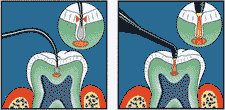
The Diagnodent is a pen-like probe that sends a safe, painless laser beam into the tooth and checks its health. A number scale and an alarm will signal when there are signs of hidden decay.
How come my dentist could not find my cavity until it was large?
With the widespread use of fluoride in both drinking water and toothpastes, it is much harder to detect tooth decay than ever before. This is because the fluoride hardens the enamel so that most decay starts in microscopic defects in the hard surface, and can readily spread into the softer surface beneath. This destroys the tooth from the inside out. The Diagnodent allows us to determine if decay is lurking beneath the apparently healthy tooth surface.
Can you use tooth colored (white) fillings in my teeth?
Absolutely!!! As a matter of fact we only place tooth colored fillings in teeth since these not only look better, but also are stronger and smaller than silver fillings. This is because tooth colored fillings are bonded in and actually help hold the remaining parts of the tooth together. Silver on the other hand is merely wedged in and does nothing to help strengthen the tooth.


Diagnodent Laser Cavity Detection Unit
How does the Diagnodent work?
The Diagnodent is a pen-like probe that sends a safe, painless laser beam into the tooth and checks its health. A number scale and an alarm will signal when there are signs of hidden decay.

The above picture shows how the Diagnodent can find cavities that other dental instruments can miss
How come my dentist could not find my cavity until it was large?
With the widespread use of fluoride in both drinking water and toothpastes, it is much harder to detect tooth decay than ever before. This is because the fluoride hardens the enamel so that most decay starts in microscopic defects in the hard surface, and can readily spread into the softer surface beneath. This destroys the tooth from the inside out. The Diagnodent allows us to determine if decay is lurking beneath the apparently healthy tooth surface.
Can you use tooth colored (white) fillings in my teeth?
Absolutely!!! As a matter of fact we only place tooth colored fillings in teeth since these not only look better, but also are stronger and smaller than silver fillings. This is because tooth colored fillings are bonded in and actually help hold the remaining parts of the tooth together. Silver on the other hand is merely wedged in and does nothing to help strengthen the tooth.

White (colored) fillings vs. silver fillings
http://www.sixmonthbraces.com/lasercavitydetection.htm
Subscribe to:
Posts (Atom)